// CASE STUDY · MEASURED 30 JULY 2026
What a website rebuild actually changes
We rebuilt Colin Clark Builders’ website from the ground up. On the last day the old WordPress site existed, we measured both versions back to back — so this is a real before and after, not an estimate. Here is every number, how we got it, and the one thing we are not claiming yet.
Rated 4.9 on GoogleFamily-run since 1995 · real people, no call centre// A DIARY, NOT A BROCHURE
Every step dated — including the ones that haven’t happened yet
Most case studies are written once, afterwards, when the numbers can be chosen. This one is a running record. The future entries below are already reserved, and they will be filled in from Google’s own Search Console data — whatever it says.
-
June – July 2026 · Done
The research
Before a single page was designed: their Search Console history read line by line, the old site crawled address by address, and the page Google was already showing ten and a half thousand times found and understood. The research nobody sees is most of the job.
- 17 ranking addresses mapped
- 100+ hidden addresses found
-
July 2026 · Done
The build
Seventy-nine pages that answer real questions, a full structured-data entity graph, an
llms.txtfor AI assistants, and the firm’s own photographs throughout. Static files — nothing to hack, nothing to patch.- 79 pages
- 1 script
- 0 plugins
-
30 July 2026 · Done
Baseline day, then launch
The old WordPress site measured on the last day it existed — the before column that can never be retaken — then the swap, with every redirect already rehearsed. Launch day was deliberately boring.
- TTFB 1,320 → 106 ms
- 111 → 15 requests
- 17/17 redirects live
-
31 July 2026 · Done
Day one — marked by our own public tool
We pointed our free website checker — the same one anyone can use on any site — at the site we had just built, and published what it returned, including what it told us to improve.
- Lighthouse 99 desktop · 90 mobile
- SEO 100
- 0 layout shift
-
29–31 August 2026 · Measured — you are here
30-day re-measure
The first 30 days of live Search Console data (30 July – 28 August), published as promised: 184 clicks from Google search — against 30 clicks in the old site’s final 30 days, from the same Search Console property. Six times the visitors, and more than half of them landed on pages that did not exist before the rebuild. The site also appeared over 1,600 times in Google’s AI answers, up from less than once a day on the old site. We are deliberately not headlining impressions: SEO-tool bots inflate them. Clicks are people. The full 30-day update explains both numbers and their caveats.
- Clicks, 30 days: 30 old → 184 new
- 6× the visitors
- 1,600+ AI-answer appearances
-
Due late October 2026 · Reserved
90-day re-measure
Long enough for Google to have recrawled everything and for rankings to start settling. The first read that means much.
- Awaiting Search Console data
-
Due late January 2027 · Reserved
180-day verdict
The one that counts: two full seasons of search data against the old site’s history. If the rebuild worked, this entry proves it. If it fell short, this entry says that instead.
- Awaiting Search Console data
// SAME BUSINESS, SAME DAY
See the difference first
Both versions photographed on 30 July 2026 — the old site’s last day. Design is taste; the tables further down are measurement. But taste is where every visitor starts.
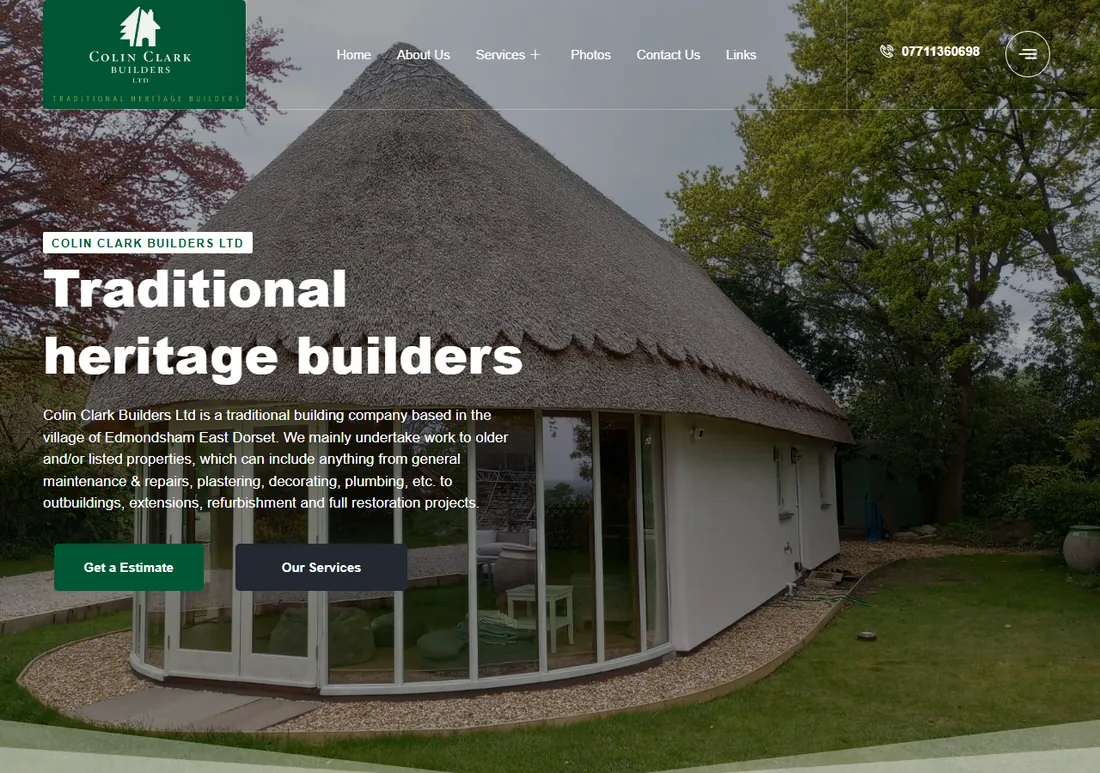
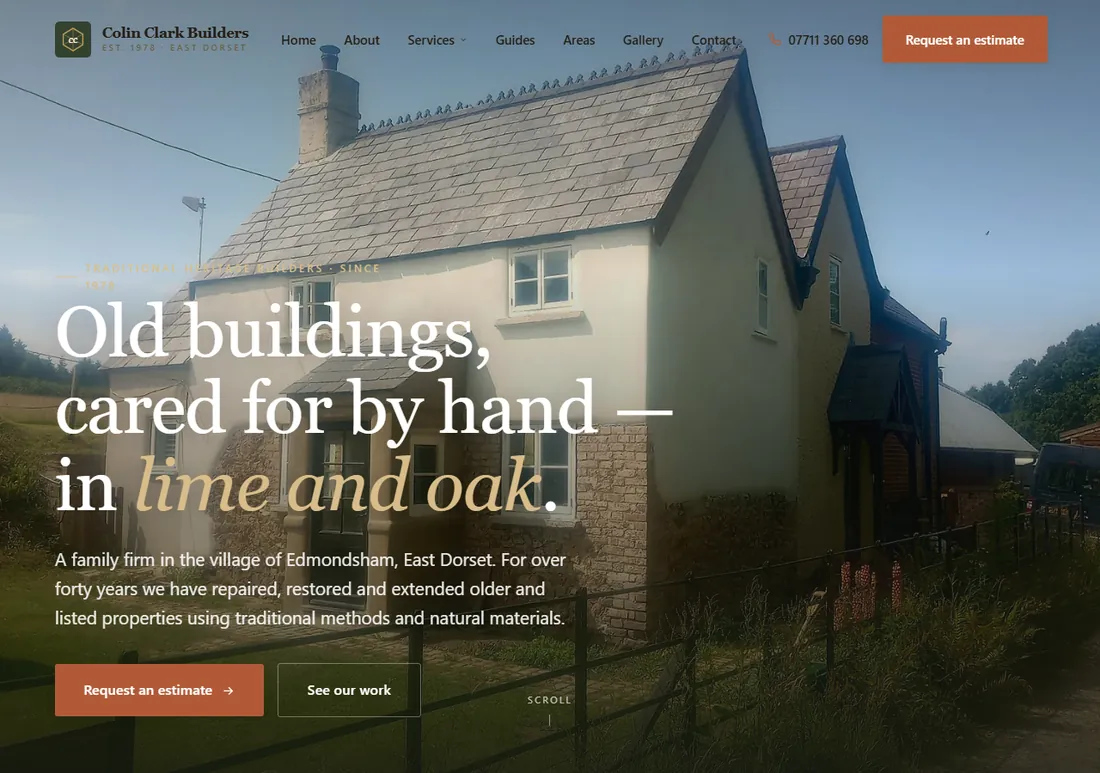


Where most of their visitors actually are. Just over half of local-service searches happen on a phone, and the phone view is where the old site struggled most. The two shots above are the same 390-pixel screen.
// THE BIT ALMOST EVERYONE SKIPS
You only get one chance to measure the old site
The moment a new site goes live, the old one stops existing. Whatever it scored, however slow it was, whatever it was missing — gone, and not recoverable. Every “before” figure on this page was captured on 30 July 2026, the day before the switch. A day later it would have been impossible.
How these were measured, so you can judge them. Both sites were loaded back to back in the same browser, on the same connection, within minutes of each other, and read with the browser’s own Performance API. One run each — so treat the timings as indicative and the counts as exact. We tried Google’s PageSpeed Insights first and hit its daily limit, which is why these are direct measurements rather than Lighthouse scores. We have left page weight out entirely: sizing uncached files tripped the host’s bot protection, and a number we cannot stand behind is worse than no number.
// PRESS PLAY AND WAIT
Both sites loading, at the speed they really did
Real time, real measurements. The new site has finished before the old one has drawn anything at all.
both lanes share one scale — full width = 2,225 ms
// HOMEPAGE, SIDE BY SIDE
The same page, before and after
| Old (WordPress) | New (static) | Why it matters | |
|---|---|---|---|
| Server response (TTFB) | 1,320 ms | 97 ms | How long the server takes to say anything at all. Nothing can be drawn until this finishes. |
| First content on screen | 1,808 ms | 544 ms | When the visitor first sees something other than white. This is the moment they decide whether to wait. |
| Page fully loaded | 2,225 ms | 461 ms | Everything done. On a phone on patchy signal, the gap widens rather than narrows. |
| Requests to load one page | 111 | 15 | Every request is a separate round trip. Most of the old ones were plugins nobody asked for. |
| JavaScript files | 53 | 1 | Fifty-three scripts is not a design decision, it is what a decade of plugins leaves behind. |
| Stylesheets | 52 | 2 | |
| HTML delivered | 226 KB | 47 KB | The page's own markup, before images. Most of the old weight was markup no reader ever sees. |
| Elements on the page | 1,150 | 503 |
// WHAT A SEARCH ENGINE COULD SEE
Speed was not the worst of it
A slow site is a problem you can feel. These are the problems nobody can see — and they are the ones that decide whether you appear in the results at all.
| Old (WordPress) | New (static) | Why it matters | |
|---|---|---|---|
| Pages in the sitemap | 20 | 79 | Twenty pages cannot answer many questions. Most searches never had a page to land on. |
| Structured data blocks (homepage) | 0 | 2 | Structured data is how a search engine knows this is a builder, in Dorset, doing these trades. |
| Meta description (homepage) | none | 152 characters | With none, Google writes its own from whatever text it finds. That is your shop window, chosen by a machine. |
| Page title (homepage) | 20 characters | 64 characters | “Colin Clark Builders” only wins if you already know the name. It says nothing about the trade or the county. |
| Headings marked as the main one | 6 | 1 | Six H1s tells a crawler the page has six subjects, which is the same as having none. |
| Images with alt text (homepage) | 0 of 12 | 14 of 15 | Alt text is what a screen reader announces and what an image search reads. Zero is a real accessibility failure, not a technicality. |
// ONE PAGE, IN DETAIL
The page that was already being found — and wasted
Search Console showed the old timber framing page being shown to people around ten and a half thousand times, mostly for searches like “timber frame bournemouth”, and almost nobody clicked. That is not a ranking problem. Google was already offering the page — it just gave people nothing to click on: no description, a title that named only the company, and four hundred words behind it.
| Old | New | |
|---|---|---|
| Page title | Timber Framing – Colin Clark Builders | Oak & Timber Frames, Bournemouth & Dorset | Colin Clark Builders |
| Meta description | none | Green oak and chestnut frames, roof trusses and whole buildings for Dorset homes — jointed and pegged by hand… |
| Structured data | 0 blocks | 4 blocks — Service, FAQPage, BreadcrumbList, plus the site-wide business entity |
| Words on the page | 400 | 663 |
| Images with alt text | 0 of 6 | 2 of 2 |
| Server response | 878 ms | 57 ms |
| First content on screen | 1,272 ms | 312 ms |
| Requests | 97 | 8 |
This is the cheapest kind of win there is. The impressions already existed. Nothing had to rank better. The page simply had to stop looking like a dead end — a title that says what the work is and where, a description written for a human, and enough substance behind the click to be worth it.
// THE PART YOU NEVER SEE
The research happens before a single page is written
Building the site took weeks. Knowing what to build is most of the job — and it is the part no screenshot can show. Six things that happened on this project before any design work started.
Their search history, read line by line
Search Console shows what Google was already doing with the old site — every query, every page, every click. That reading is where the timber framing page’s ten and a half thousand wasted impressions were found. Not guessed: read.
Every address the old site ever had
A crawl of the live site, cross-checked against Search Console and the old site’s own media interface — which quietly held over a hundred addresses a crawl alone would have missed. You cannot protect an address you never found.
The actual results pages, looked at by hand
For the searches that matter to a heritage builder, we looked at what Google actually shows — who ranks, what kind of page wins, what question the searcher is really asking — and wrote pages that deserve a place there, rather than pages that ask for one.
The trade’s own language, learned
Cob, lime versus cement, green oak, listed-building consent, VAT relief on listed work. The pages are written in the words homeowners and conservation officers actually use — and checked with the firm, because they are the experts, not us.
A page only where there was a question
Seventy-nine pages exist because there were seventy-nine things genuinely worth answering — services, materials, towns, and the questions behind the searches. Not one page was added to pad a sitemap; thin pages hurt more than they help.
The launch, rehearsed like a fire drill
Every redirect rule replayed by script against every known old address — before go-live, not after. It is why launch day produced no drama and no lost rankings to apologise for. Boring launches are engineered.
// THE RISKY PART
How a rebuild loses everything, and how we stopped it
The real danger in replacing a website is not the design. It is that every address Google already knows quietly stops working, and years of standing evaporates in a fortnight.
The old address list came from three places
Search Console for what actually ranked, a crawl of the live site for what existed, and the old site’s own media interface — which revealed over a hundred addresses a crawl alone would have missed.
Every rule was tested before launch
We replayed the redirect rules against every old address in a script, rather than trusting them. 17 of 17 old ranking addresses land on a real page, and none of the 79 new pages gets hijacked by a stray rule.
12 of 17 keep their exact address
A redirect passes on most of a page’s standing, but not being redirected at all is better. Where the old address made sense, the new site simply uses it.
// MARKED BY OUR OWN FREE TOOL
We ran our own build through our own public checker
Our free website checker runs Google’s Lighthouse engine against any site and shows the result, good or bad. The day after launch we pointed it at the site we had just built. These are the scores it returned on 31 July 2026 — including the two things it told us to improve.
90
Performance · mobile
100
SEO
96
Accessibility
100
Best practices
-
Desktop performance: 99 of 100
Largest content painted in 1.0 second. The mobile 90 above is measured under simulated slow-4G throttling — the stricter test, and the one Google indexes by, which is why we lead with it rather than the prettier number.
-
SEO: 100
A proper title, a 152-character description, one clear heading, a canonical address, structured data and a 79-page sitemap. Everything the old site was missing, verified by an engine we do not control.
-
Best practices: 100
HTTPS everywhere, no console errors, no deprecated code. Largely a consequence of there being almost no code to get wrong — one script, one stylesheet.
-
Measured from a real browser: 61 ms server response, zero layout shift
Read with the browser’s own Performance API on 31 July, the same method as every other number on this page. Nothing moves while the page loads — that is the “zero”.
-
Accessibility: 96, not 100
Lighthouse flagged one text-and-background pair as low contrast. It is on the fix list. A case study that only shows the passes is an advert.
-
Also flagged: image delivery, and no HSTS header yet
Mobile images could be tighter, and the server does not yet tell browsers to insist on HTTPS for future visits. Both queued. Publishing what our own tool finds wrong with our own work is the entire point of having the tool.
Run any site through the same checks — yours, ours, a competitor’s: the free website checker is one of twenty free tools we publish. No sign-up, and it will tell you the truth, because it tells it about us too.
// THE PART OTHER CASE STUDIES LEAVE OUT
What we are not claiming — yet
On the day this was written the new site had not been live for a single day. It has no rankings of its own, no traffic of its own and has not produced one enquiry. So this page does not claim any of those things, and you should be wary of any agency case study that would.
Everything above is a measurement of what was built: the site answers faster, there are far more questions it can answer, and a search engine can finally tell what the business does and where. Those are the conditions for being found. They are not the same as being found.
We took the baseline the day before launch precisely so there is something honest to compare against. We will measure again at 30, 90 and 180 days from real Search Console data, and this page will be updated with what actually happened — including if it is less than we hoped.
Update, launch day: the new site went live on 30 July 2026, and the first measurement on the live domain matched the build — server response 106 ms, first paint 412 ms, zero layout shift. Every old ranking address was re-tested live: all of them land on a real page, and the WordPress leftovers answer 410 Gone. The 30/90/180-day clock starts now.
Update, 30 days (measured 29–31 August 2026): the first re-measure is in, and this time both columns come from the same place: Search Console’s three-month view still reaches back across the launch, so the old site’s last weeks and the new site’s first weeks sit in one report, measured identically. In its final 30 days the old site earned 30 clicks from Google search. In its first 30 days live (30 July to 28 August) the new site earned 184 clicks — six times as many, for the same business, in the same season, spread across more than forty different pages. More than half of those clicks went to pages that did not exist before the rebuild, and the guides did the heaviest lifting: the page on restoring oak beams was clicked 17 times in the first 28 days, and the heritage building costs guide 15 times at an average position of 6. In Google’s AI answers — where the old site appeared less than once a day — the new one appeared over 1,600 times in its first month.
What we are deliberately not quoting: impressions. Search Console reports 11,553 of them for the same 30 days, and we could headline that number — but a large share is SEO software, not people: rank-tracking bots running other firms’ keyword lists, including searches for towns in Essex this Dorset builder will never work in. It is the same pollution that made the old timber page’s ten and a half thousand impressions so misleading, and a case study built on it would be a story, not a measurement. Clicks are people, so clicks are what we count. Still unclaimed, because it is still unknown: whether this becomes enquiries and won work. The 90-day re-measure is reserved above for late October.
The straight-answer promise. If we look at your site and a rebuild is not worth your money, we will tell you so — in writing, in the verdict. Sometimes the honest answer is a smaller fix, and sometimes it is “leave it alone”. We would rather lose a job than build something you did not need.
// NO MYSTERY PROCESS
What happens if you get in touch
Send us your web address
Or ring 01202 775566. That is all we need to start — no meeting, no forms.
We measure it, free
The same checks you have just read: server response, requests, what a search engine can and cannot see.
A written verdict, either way
Rebuild, fix what is there, or leave it alone. If a rebuild is not worth your money, the verdict says so.
If it is a rebuild
A fixed, published price agreed in writing before we start — and your old site stays live until the new one is ready, which is exactly how this one could be measured the day before its swap.
// GOOD QUESTIONS
Frequently asked
Does rebuilding a website improve your Google ranking?
Not on its own, and anyone promising otherwise is guessing. What a rebuild can do is remove the reasons a search engine had to ignore you: pages that load slowly, no description for Google to show, no structured data explaining what the business does, and too few pages to answer what people actually type. Fix those and you have earned the chance to rank. You still have to be genuinely useful, and you still need reviews and local signals. On this project we measured the technical change on day one and are deliberately not claiming a ranking result yet.
Is WordPress bad for SEO?
No. WordPress powers an enormous amount of the web perfectly well, and this same client sat on it happily for years. The problem is what a decade of plugins does to a site nobody is actively maintaining. The old site here was loading 53 JavaScript files and 52 stylesheets to show one page — not because anyone chose that, but because each plugin brought its own. If you have someone maintaining WordPress properly, keep it. If you do not, it quietly rots.
What is a static site, in plain English?
Every page is built once, in advance, into a plain file. When somebody visits, the server hands over that file — no database lookup, no plugins running, nothing to assemble. It is why the server response went from 1,320 milliseconds to 97. It also means there is no admin login to break into and no plugin updates to forget, which is most of how small business sites get hacked.
Will I lose my Google rankings when the site changes?
That is the real risk, and it is the part that needs the most care. Every old address has to keep working or land somewhere sensible. On this rebuild we took the old page list from three separate sources — Search Console, a crawl of the live site, and the old site’s own media API — then tested the redirect rules against every one before launch: 17 of 17 old ranking addresses land on a real page, and 12 of those keep their exact address. That test is the difference between a rebuild and a disappearance.
How long before a rebuild shows results?
Longer than anyone wants. Google has to recrawl, and it re-earns its judgement slowly. Weeks for the technical changes to be noticed, months before rankings settle. We measure at 30, 90 and 180 days against the baseline taken the day before launch — which is why taking that baseline matters so much. If nobody measured the old site, there is nothing to compare with, and every claim afterwards is just a story.
How do I make changes to a static site afterwards?
You tell us, and we make them — that is part of 365 Web Care, the monthly plan that follows a rebuild. In practice it is usually faster than logging into WordPress yourself, and nothing can be broken by a plugin update on the way. If you genuinely edit content every week, say so up front — that is one of the cases where we would tell you a static rebuild is the wrong answer.
Can you do this for my website?
Yes — and the first useful thing is free. Run your site through our free website checker and it will show you the same kinds of problems we found here: missing descriptions, slow responses, missing structured data. If a rebuild is not worth it we will say so; sometimes fixing what is there is the better answer. Or just ring 01202 775566 or send us your web address and we will look at it with you.
Wondering about your own site?
Send us your web address and we will reply with the same before-tables you have just read, for your site, and a straight verdict — rebuild, fix what is there, or leave it alone. If a rebuild is not worth it, we will tell you that too, in writing. And a rebuild is a fixed, published price, agreed before we start — not a number invented after we have sized you up.
01202 775566 · help@365techies.co.uk · MON–FRI 9AM–5PM